This post contains affiliate links. As an Amazon Associate we earn from qualifying purchases, at no extra cost to you. Read our disclosure.
Key takeaways
- Sit about 1 to 1.5 times the screen size from a 4K TV.
- Keep the middle of the screen near seated eye level, about 40 to 42 inches up.
- Put the TV at a right angle to the main window to cut glare.
- Leave 30 to 36 inches for main walkways.
- Tape the layout on the floor before moving heavy furniture.
- Use a console, floor stand or rolling stand if you cannot mount the TV.
In this post17 sections
- The numbers behind a small living room layout with a TV
- Supplies for planning the layout
- How to plan your layout in 5 steps
- 9 small living room layouts with a TV
- 1. Sofa facing the TV on the long walls
- 2. Two zones in a long, narrow room
- 3. A corner TV that frees up the walls
- 4. TV at a right angle to the window
- 5. An L-shaped sectional in a square room
- 6. A floating sofa in an open studio
- 7. Swivel chairs for TV and conversation
- 8. A TV and desk on one wall
- 9. A rolling TV stand for the tiniest rooms
- Renter-safe ways to place the TV
- Common small living room layout mistakes
- Plan it on paper before you move a thing
- FAQ
The numbers behind a small living room layout with a TV
Three measurements decide whether a layout works: how far you sit from the screen, how high the screen sits, and how wide the walkways are. Get those right and almost any furniture can work in a small room.
For a 4K TV, guidance from retailers such as Crutchfield and reviewers such as What Hi-Fi puts the seating distance at about 1 to 1.5 times the screen size. That is closer than most people expect, which is good news for small rooms.
| Screen size | Closest seat | Farthest seat |
|---|---|---|
| 43 inch | 3.6 ft | 5.4 ft |
| 50 inch | 4.2 ft | 6.3 ft |
| 55 inch | 4.6 ft | 6.9 ft |
| 65 inch | 5.4 ft | 8.1 ft |
Aim for the middle of the screen to sit near seated eye level, about 40 to 42 inches from the floor for most sofas. Leave 30 to 36 inches for main walkways, and about 14 to 18 inches between the sofa and the coffee table.
Supplies for planning the layout
What you need (mostly free)
How to plan your layout in 5 steps
-
Step 1: Mark the fixed points
Sketch the room and mark the windows, doors, radiators, outlets and the cable or antenna jack. The TV usually wants to be near an outlet, and you do not want it facing a window.
-
Step 2: Pick the TV wall
Choose a wall that is not opposite a window and not in front of one. A wall at a right angle to the main window cuts glare the most. In many small rooms this leaves only one or two real choices, which makes the decision easier.
-
Step 3: Place the sofa by distance
Use the table above to set the sofa's distance from the screen. If the room is short, choose a smaller screen or a deeper sofa that pulls your eyes forward, rather than pushing the sofa into the walkway.
-
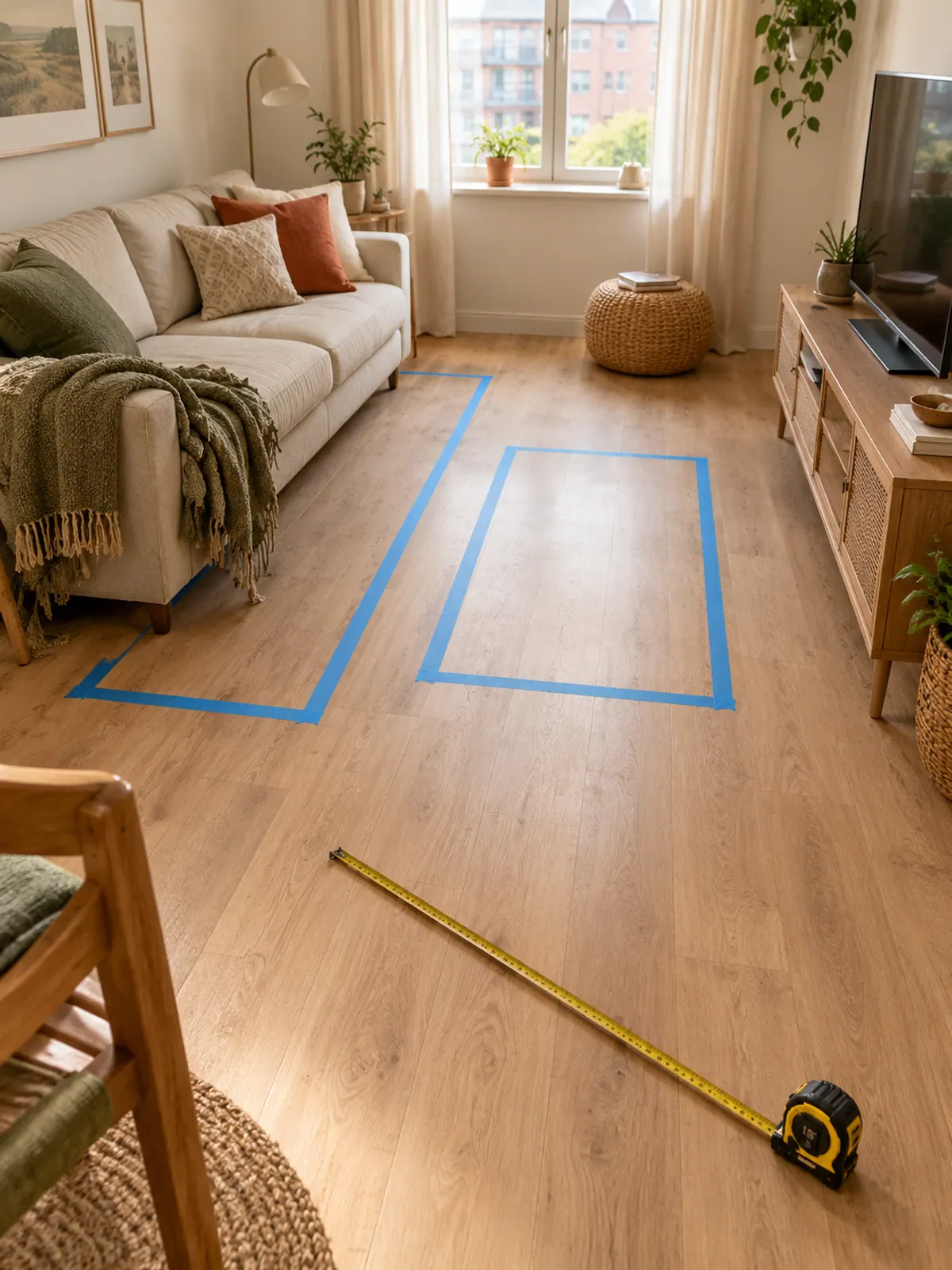
Step 4: Tape it out on the floor
Outline the sofa, coffee table and TV console with painter's tape and walk the room for a day. You will feel a tight walkway or a blocked door long before you move anything heavy.
-
Step 5: Add the second seat and the lamps
Add a chair, pouf or floor cushion where it can see the screen and still talk to the sofa. Then put a lamp near each seat so the room is not lit only by the TV at night.
9 small living room layouts with a TV
Each layout below fits a common room shape. Find the one that looks like your floor plan, then adjust for your own doors and windows.
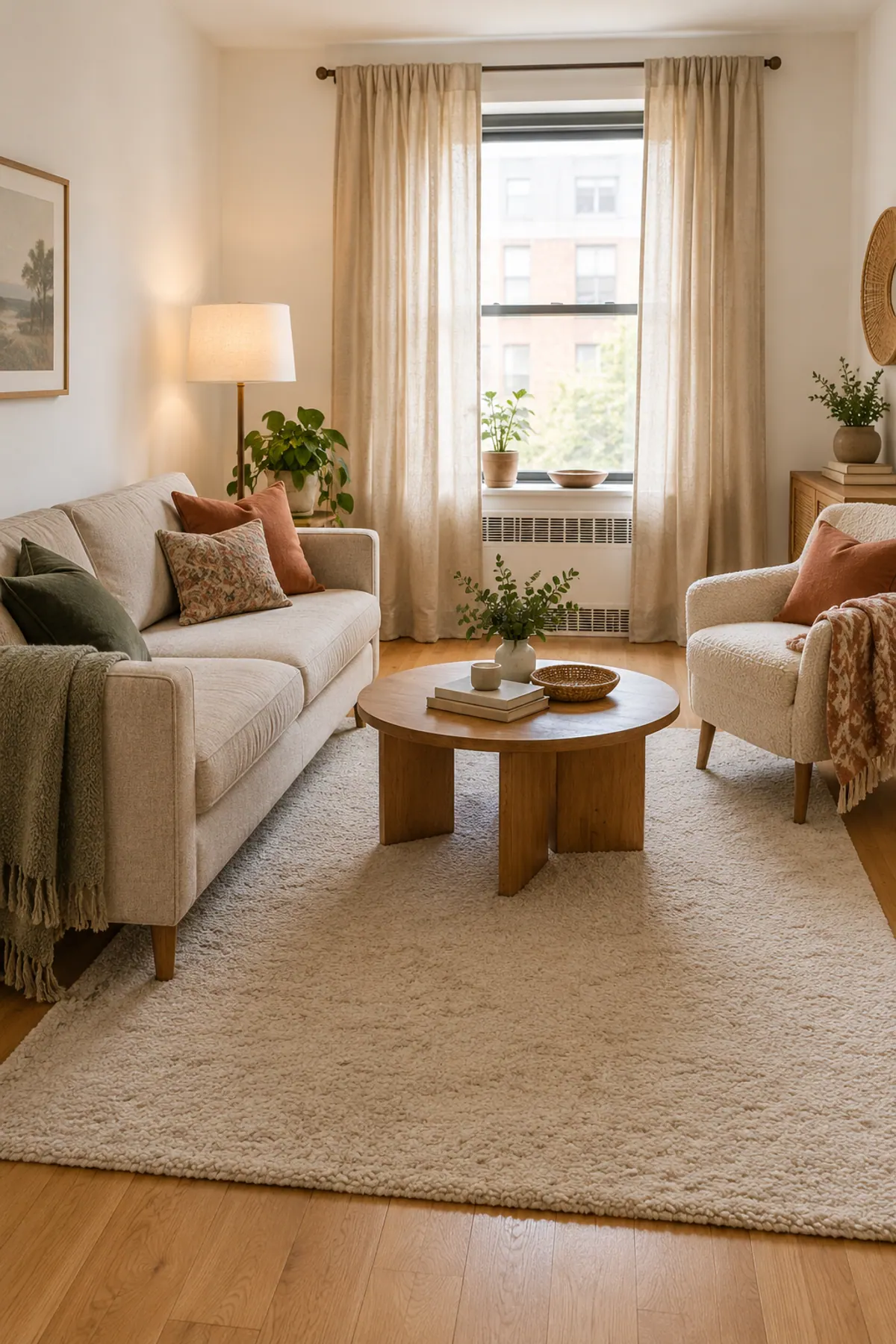
1Sofa facing the TV on the long walls
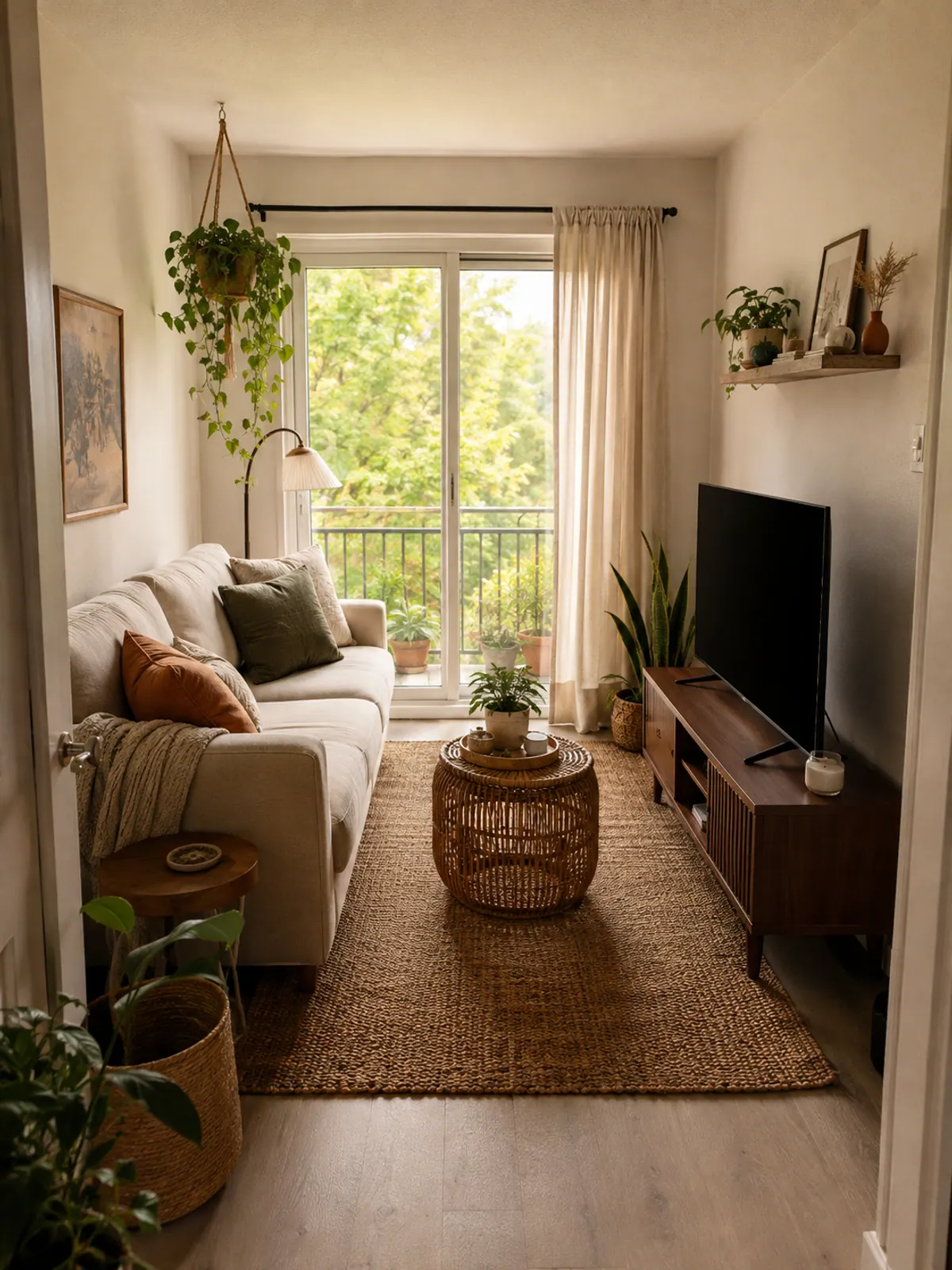
The simplest layout puts the sofa on one long wall and the TV on the wall across from it. The coffee table sits between them and the walkway runs along the short end of the room.
It works because nobody has to turn their head to watch, and the path to the door stays clear. If the room is wider than about 11 feet, float the sofa a little off the wall so the distance to the screen stays comfortable.
Best for: Rectangular rooms with the door on a short wall.
Watch out for: A window behind the sofa can reflect in the screen in the afternoon.
- Center the TV on the sofa, not on the wall, if the two do not line up.
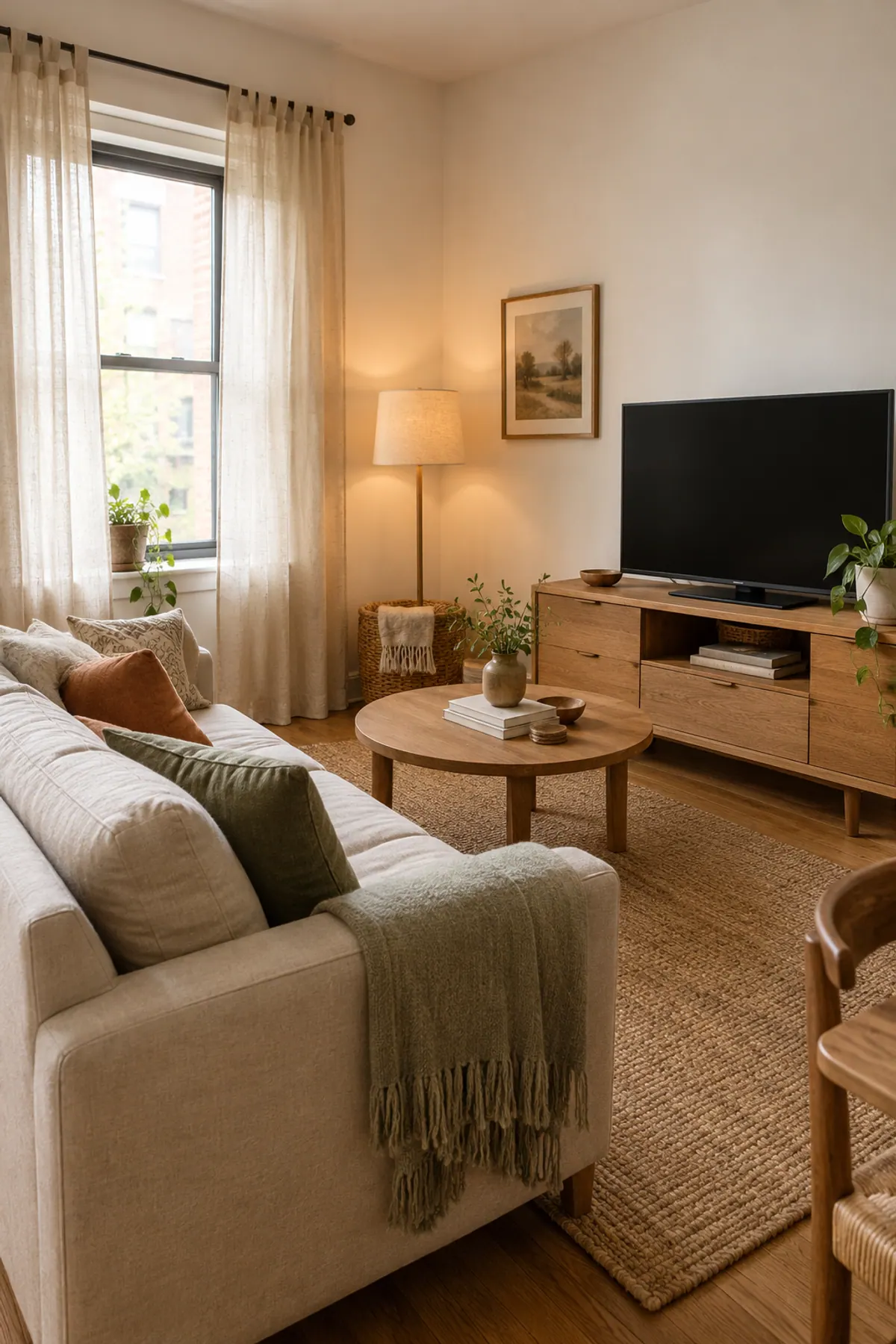
A low, long base keeps the screen near seated eye level and gives cords a place to hide.
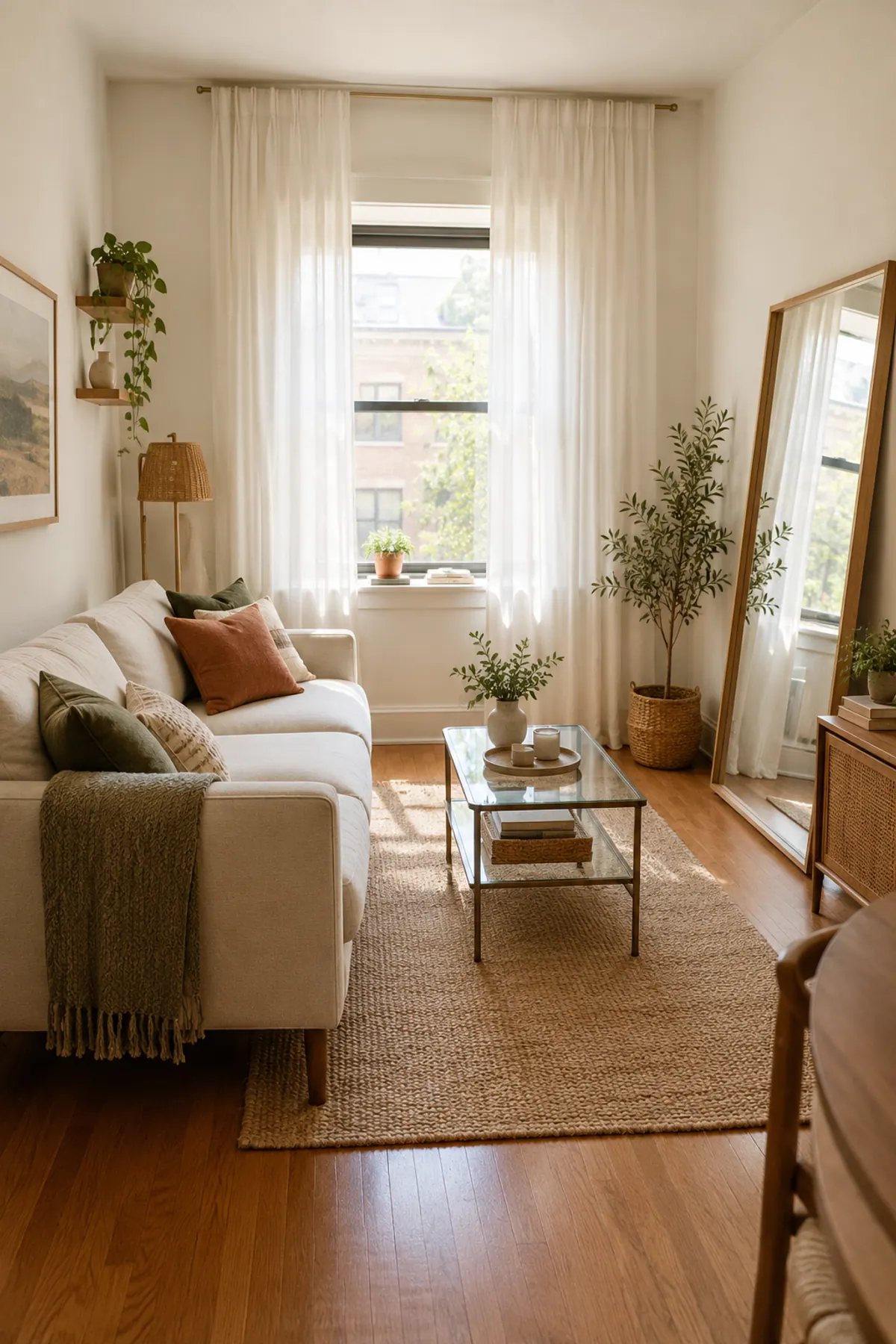
2Two zones in a long, narrow room
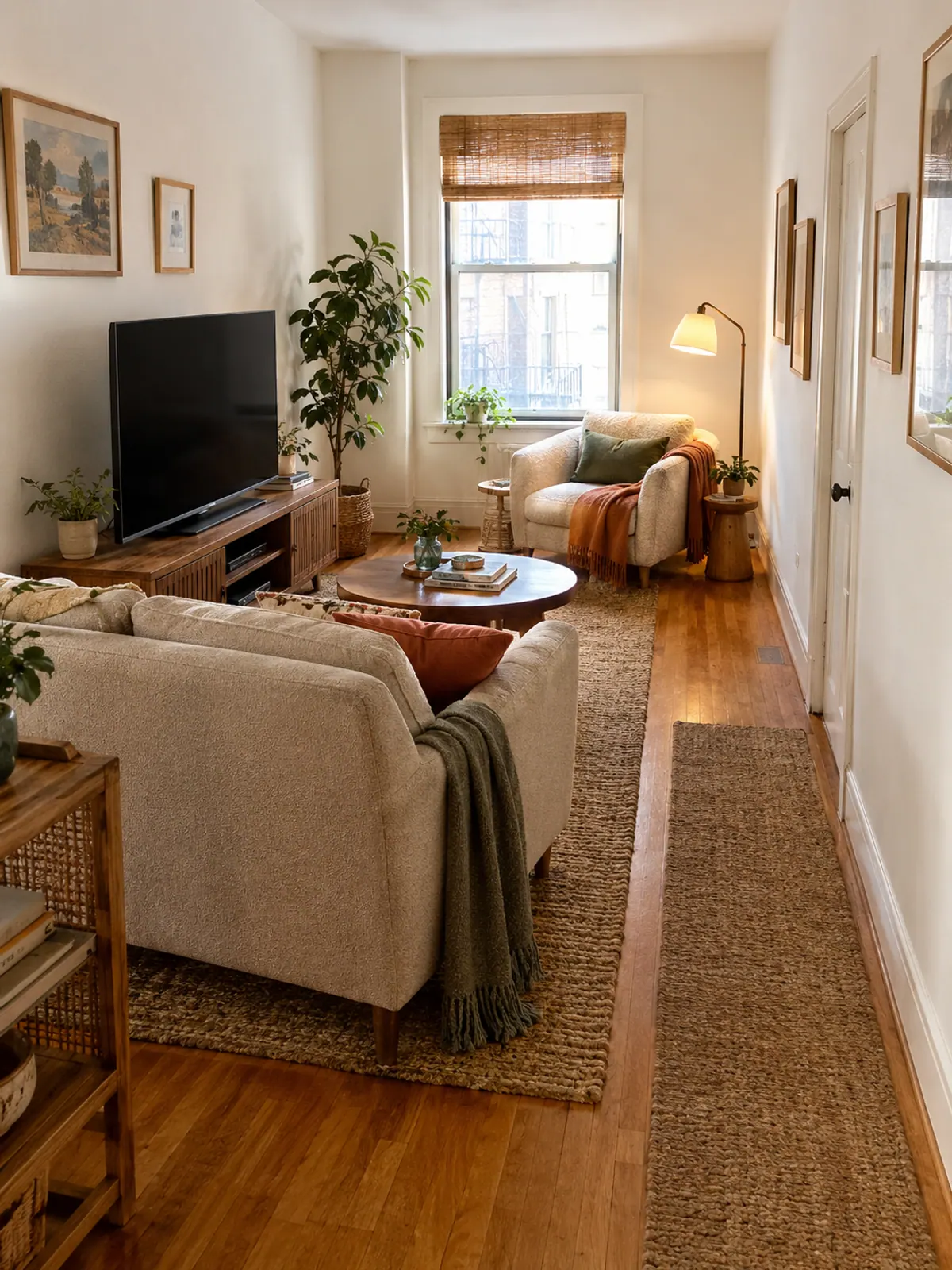
A long, narrow room rarely works as one big space. Split it in two: a TV zone with the sofa facing the screen across the width, and a second zone at the far end for reading, a desk or a small dining table.
A rug under the TV zone and a narrow console behind the sofa tell the eye where one area ends. The walkway runs down one side instead of through the middle.
Best for: Bowling alley rooms and long open living rooms in older apartments.
Watch out for: Pushing all the furniture against the walls, which makes the room feel like a hallway.
- Keep the TV on a short wall only if the room is narrow enough that the sofa still sits within the distance chart.
A slim table marks the edge of the TV zone in a long room and holds a lamp.
3A corner TV that frees up the walls
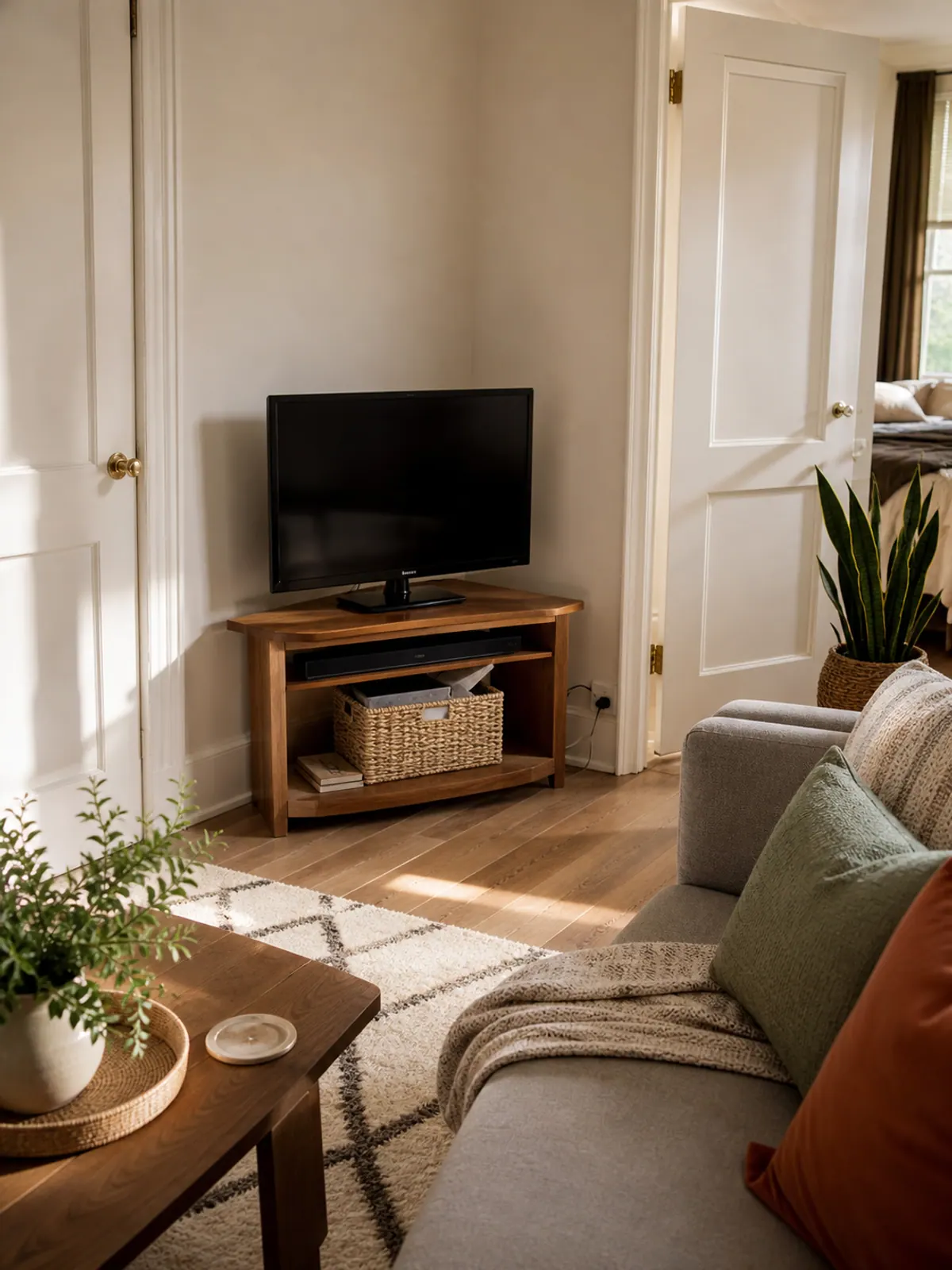
When every wall has a door, a window or a radiator, the corner is often the only spot left. A corner stand angles the screen so it faces the middle of the room.
The sofa then goes on one wall and a chair on the other, both looking toward the corner. This also opens the long walls for shelves or art.
Best for: Square rooms and rooms broken up by doors.
Watch out for: A corner next to a window, where the glare is the worst.
- Measure the corner's depth from the point of the corner, since angled stands take more room than they look.
Made to sit at an angle so the screen faces the room from a dead corner.
4TV at a right angle to the window
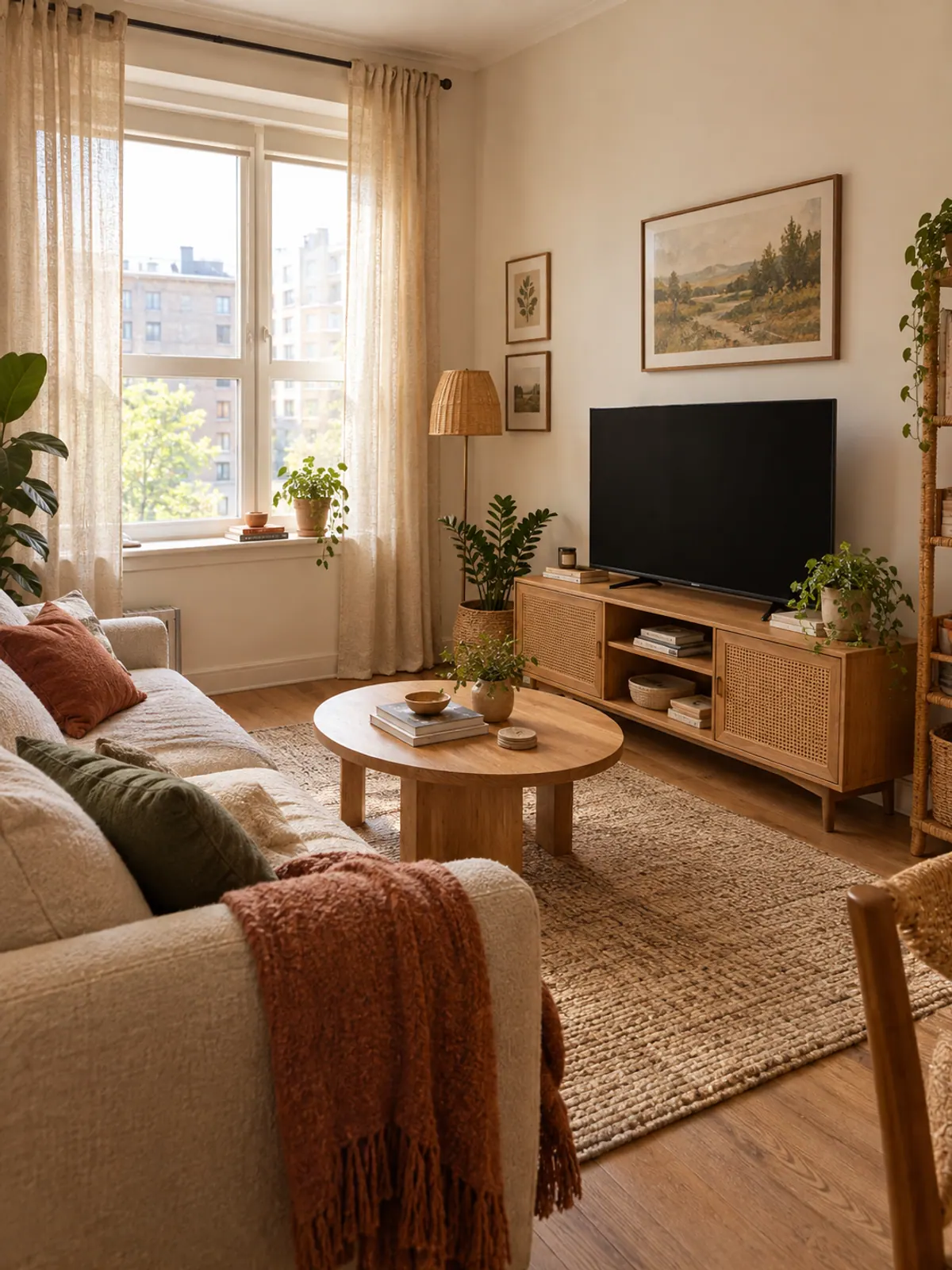
Glare is the main complaint in small, bright rooms. Putting the TV on a wall at a right angle to the main window keeps sunlight from hitting the screen head on and keeps you from squinting into the light.
The sofa then faces the TV with the window off to one side. Light filtering curtains handle the bright afternoon hours without making the room dark.
Best for: Rooms with one big window and a sunny afternoon.
Watch out for: A TV directly opposite or in front of a window, which is the hardest spot to watch from.
- Check the spot at the brightest time of day before you commit.
Softens afternoon glare on the screen while still letting daylight in.
5An L-shaped sectional in a square room
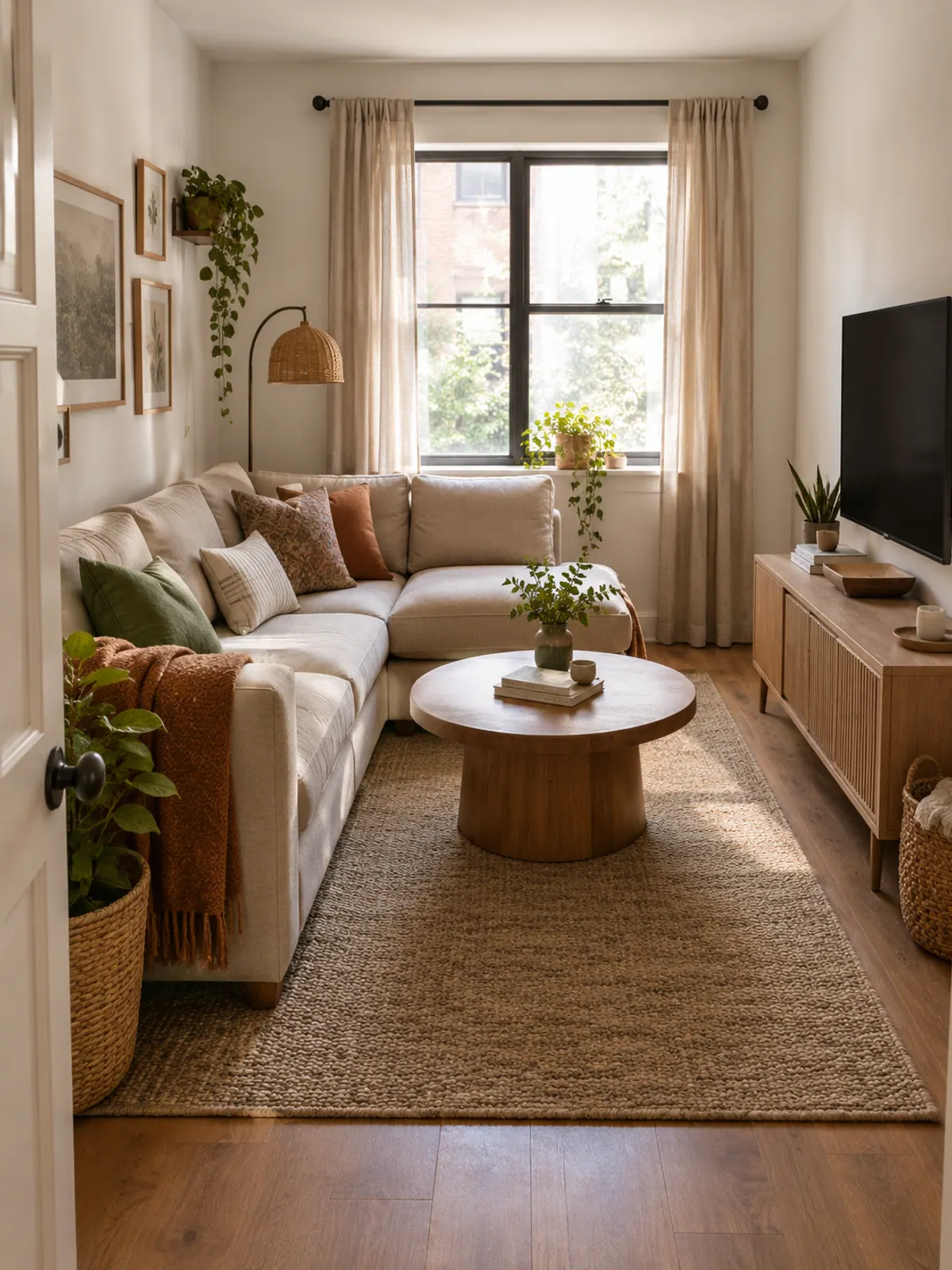
A small L-shaped sectional fits neatly into a square room. Tuck the L into the corner farthest from the door and put the TV across from the longer side.
You get more seats than a sofa and chair would give you, with no second piece to walk around. A round coffee table is easier to pass than a rectangle in the corner of the L.
Best for: Square rooms of about 11 by 11 feet or more.
Watch out for: A chaise that sticks into the doorway path.
- A reversible chaise lets you flip the L if you move.
A reversible chaise lets you flip the L to fit the room you have now and the next one.
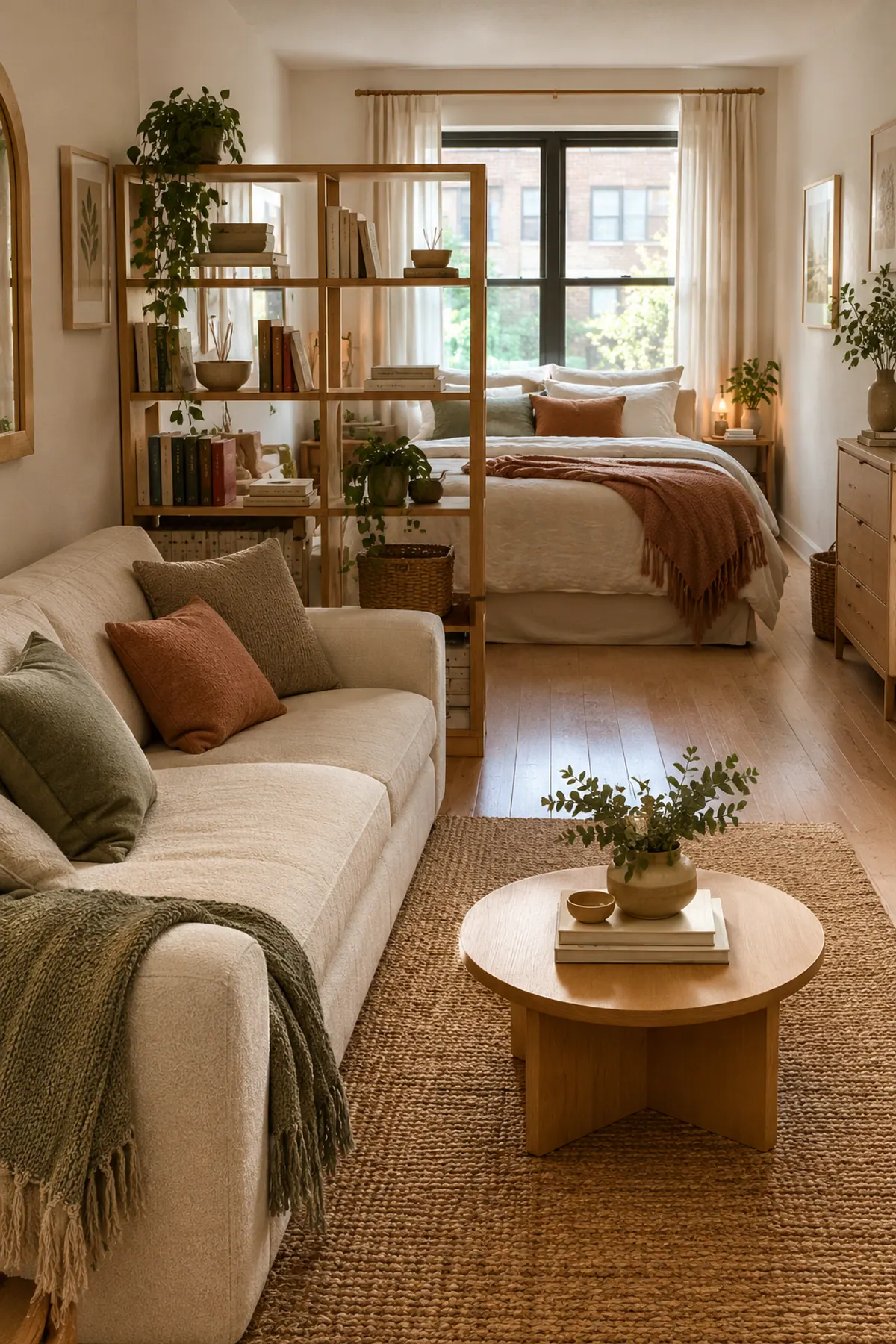
6A floating sofa in an open studio
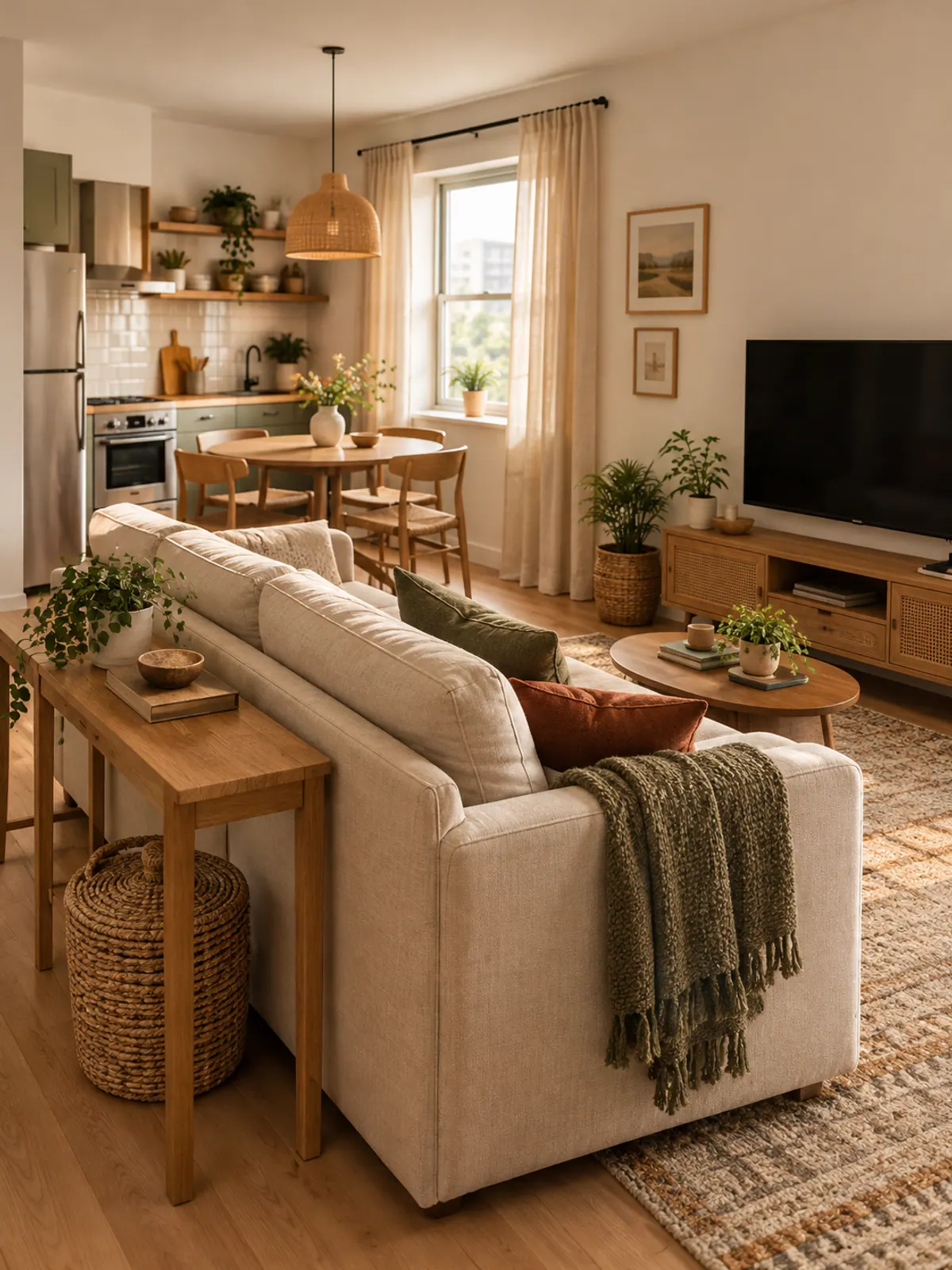
In a studio, the back of the sofa can do the work of a wall. Float the sofa so it faces the TV, with its back to the bed or kitchen, and the living area has a clear edge.
An open bookcase or a console table behind the sofa makes the line stronger. Our studio apartment layout ideas show this with real dimensions, and our studio divider guide compares shelves, curtains and screens.
Best for: Studios and open plan rooms.
Watch out for: A sofa back that blocks the path to the bathroom.
- Pick a sofa with a finished back, since everyone will see it.
Open backs split a studio into zones without blocking window light.
7Swivel chairs for TV and conversation
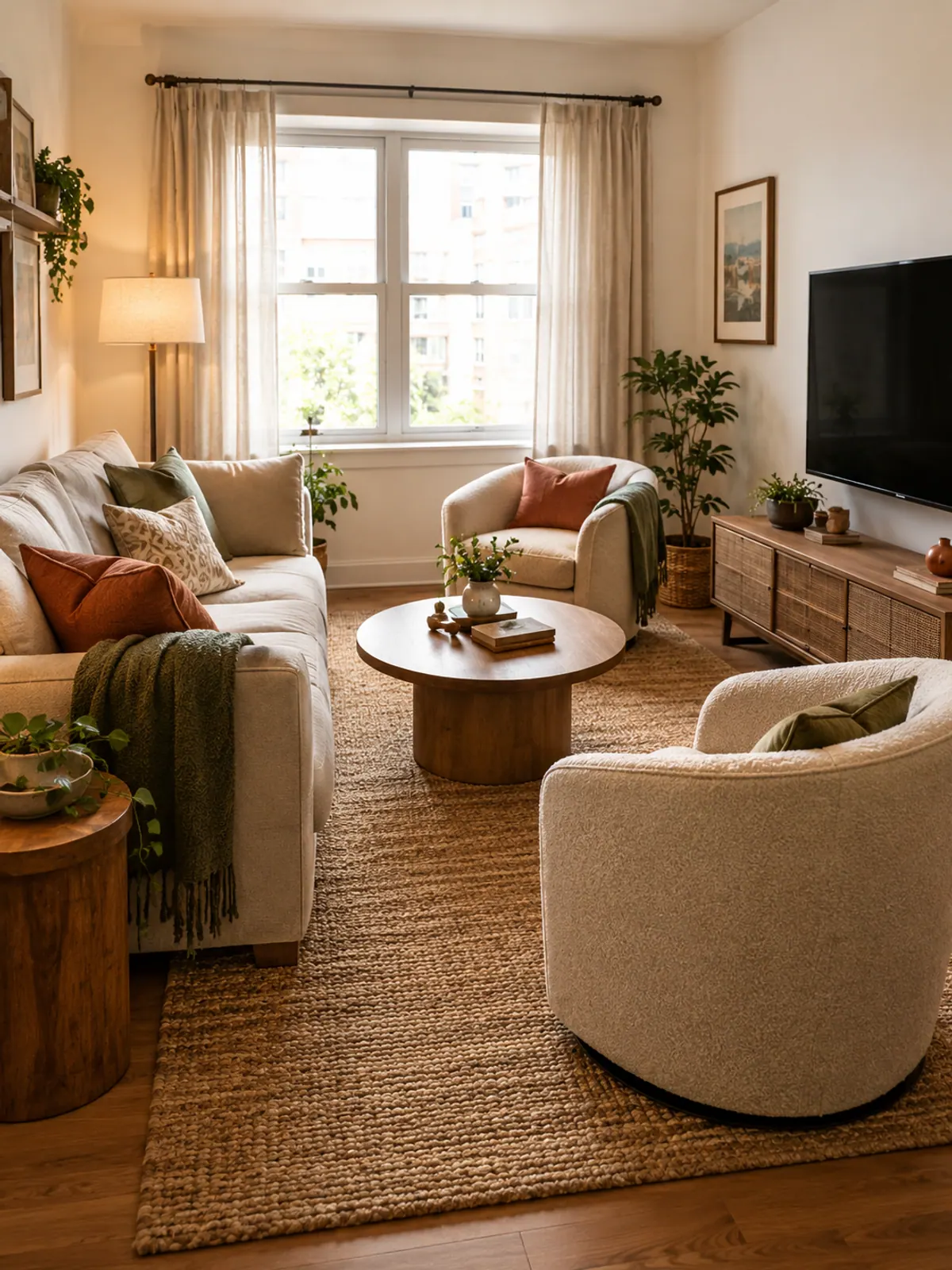
If you talk with guests more than you watch TV, a loveseat plus two swivel chairs gives you both. The chairs face the sofa for conversation and turn toward the TV for a movie.
This layout needs less depth than a big sofa, so it works in rooms that are wide but short. Choose small chairs with a low back so they do not block the screen from the sofa.
Best for: People who host often.
Watch out for: Chairs too large for the room, which crowd the walkway.
- Look for chairs under about 30 inches wide for small rooms.
Turns toward the TV for a movie and back toward the sofa for conversation.
8A TV and desk on one wall
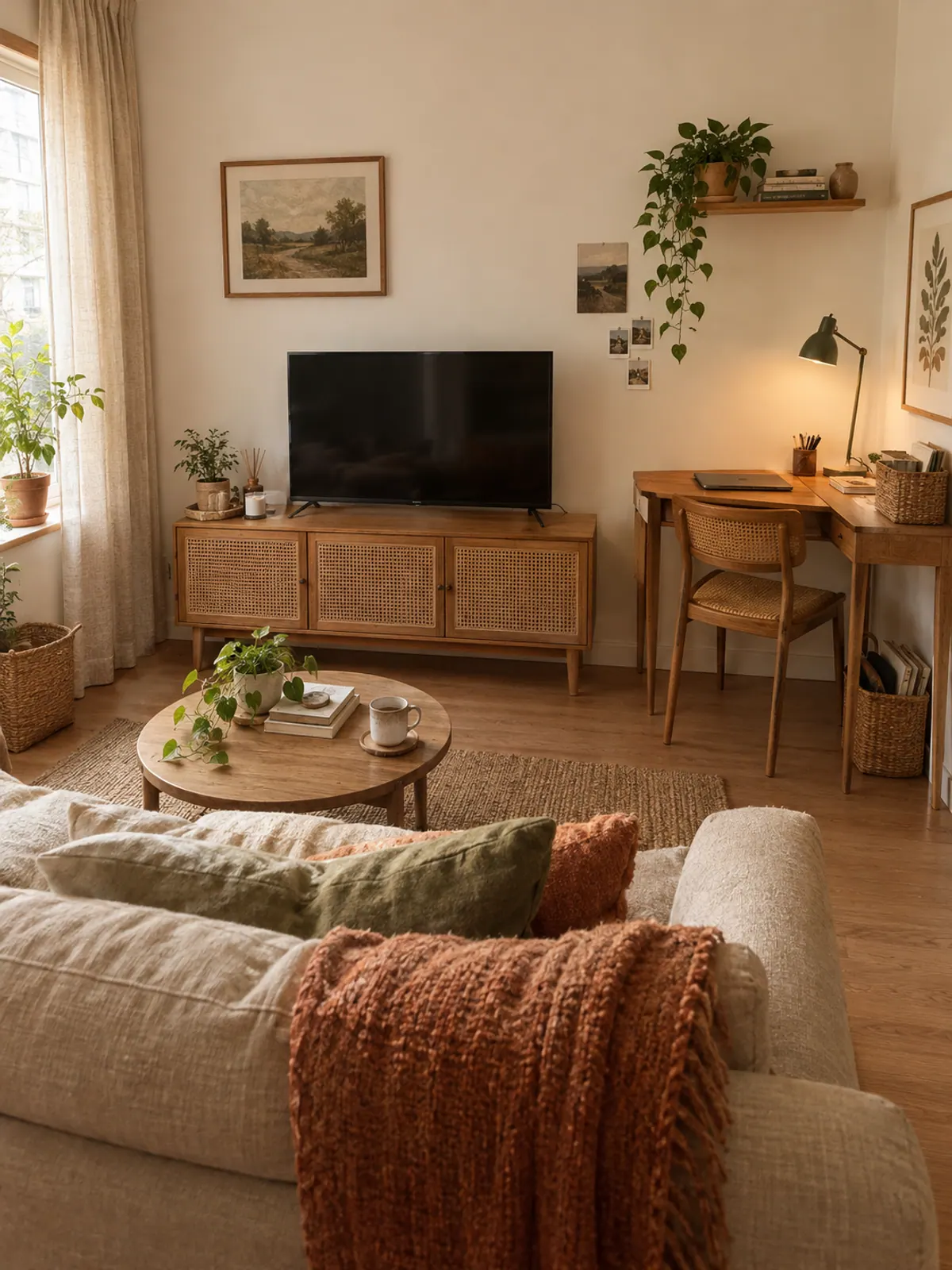
When the living room is also the office, one wall can hold both. Put the TV on a low console and a small desk beside it, with the sofa facing the whole wall.
Work stays on one side of the room and off the coffee table. A lamp on the desk lights the work spot without turning on the overhead light.
Best for: One bedroom apartments with no spare room for a desk.
Watch out for: A desk chair that sticks out into the walkway when you are not using it.
- Pick a chair that slides fully under the desk.
A compact desk fits beside a TV console on one wall without crowding it.
9A rolling TV stand for the tiniest rooms
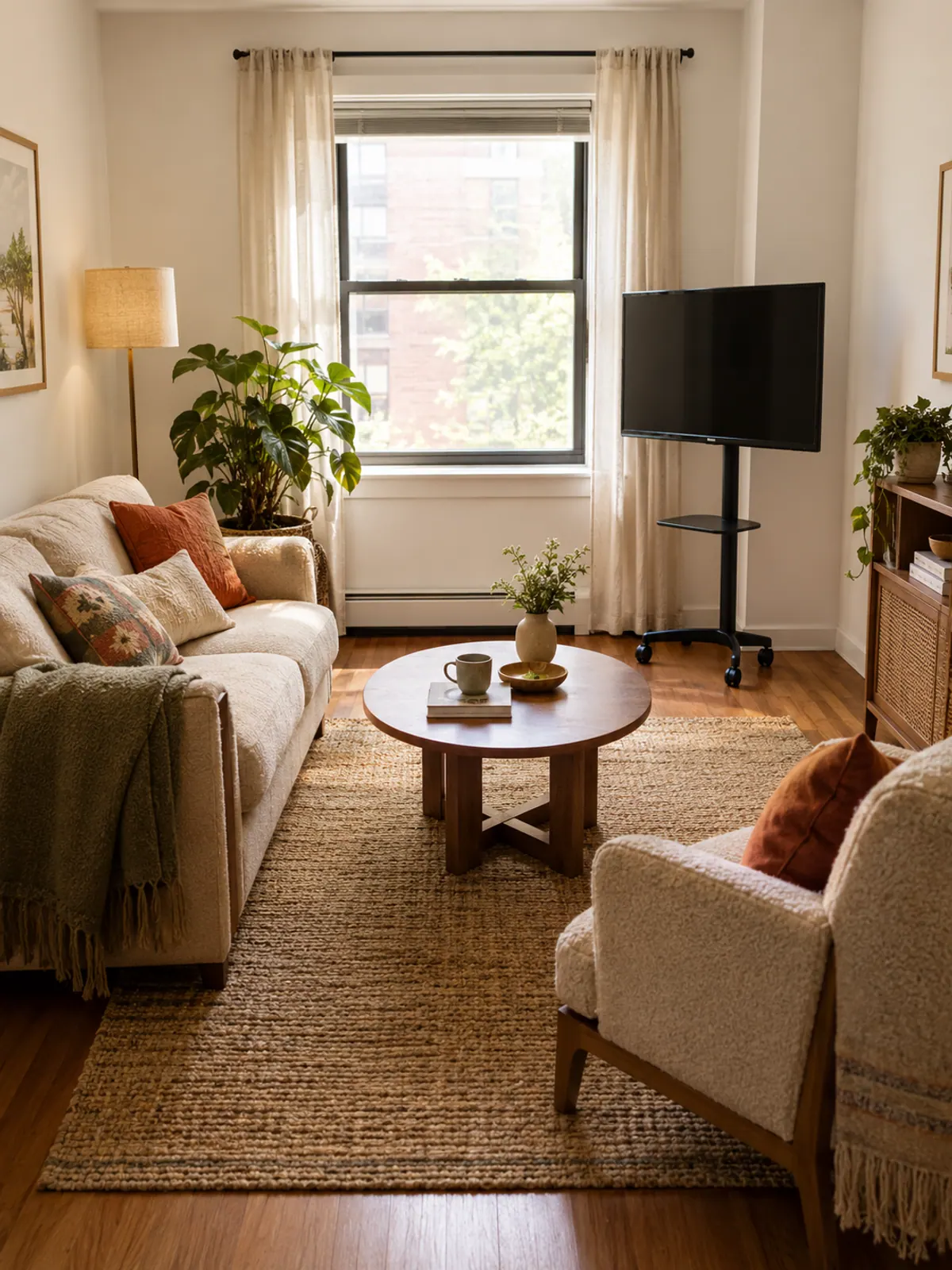
In the smallest rooms, the TV does not need a permanent wall. A rolling stand holds the screen at the right height and moves where you need it, then rolls into a corner when friends come over.
Because the TV is mounted to the stand, there are no holes in the wall. Lock the wheels when it is in place.
Best for: Tiny living rooms and studios that double as guest rooms.
Watch out for: Rolling it over rugs, where it can catch; keep it on the bare floor.
- Use the strap or bracket that comes with the stand, and lock the wheels every time.
Holds the TV at a set height with no wall holes and rolls away when you need the floor.
Renter-safe ways to place the TV
Many leases do not allow wall mounts, or charge for patching big anchor holes. Before you drill, check the lease or ask the landlord in writing.
| Option | Holes in the wall | Best for |
|---|---|---|
| Low TV console | None | Most rooms; keeps the screen near eye level |
| Floor TV stand with mount | None | Rooms where the wall is not allowed or not strong enough |
| Rolling TV stand | None | Tiny rooms and shared spaces |
| Corner TV stand | None | Rooms with no free wall |
| Wall mount | Several large anchor holes | Only with written permission from your landlord |
Common small living room layout mistakes
Skip these
If the room still feels cramped after the layout is set, our designer tricks to make a small room look bigger cover mirrors, curtains and scale. Shopping for a new sofa? Start with our compact sofas for small living rooms.
Layout helpers
-
Painter's tape, 1.4 inch
Typically $5 to $12 a roll
Outline furniture on the floor before you lift anything heavy.
Check price on Amazon for Painter's tape, 1.4 inch -
Low TV console, 55 to 60 inch
Typically $90 to $250
A low, long base keeps the screen near seated eye level and gives cords a place to hide.
Check price on Amazon for Low TV console, 55 to 60 inch -
Rolling TV stand with mount
Typically $70 to $160
Holds the TV at a set height with no wall holes and rolls away when you need the floor.
Check price on Amazon for Rolling TV stand with mount -
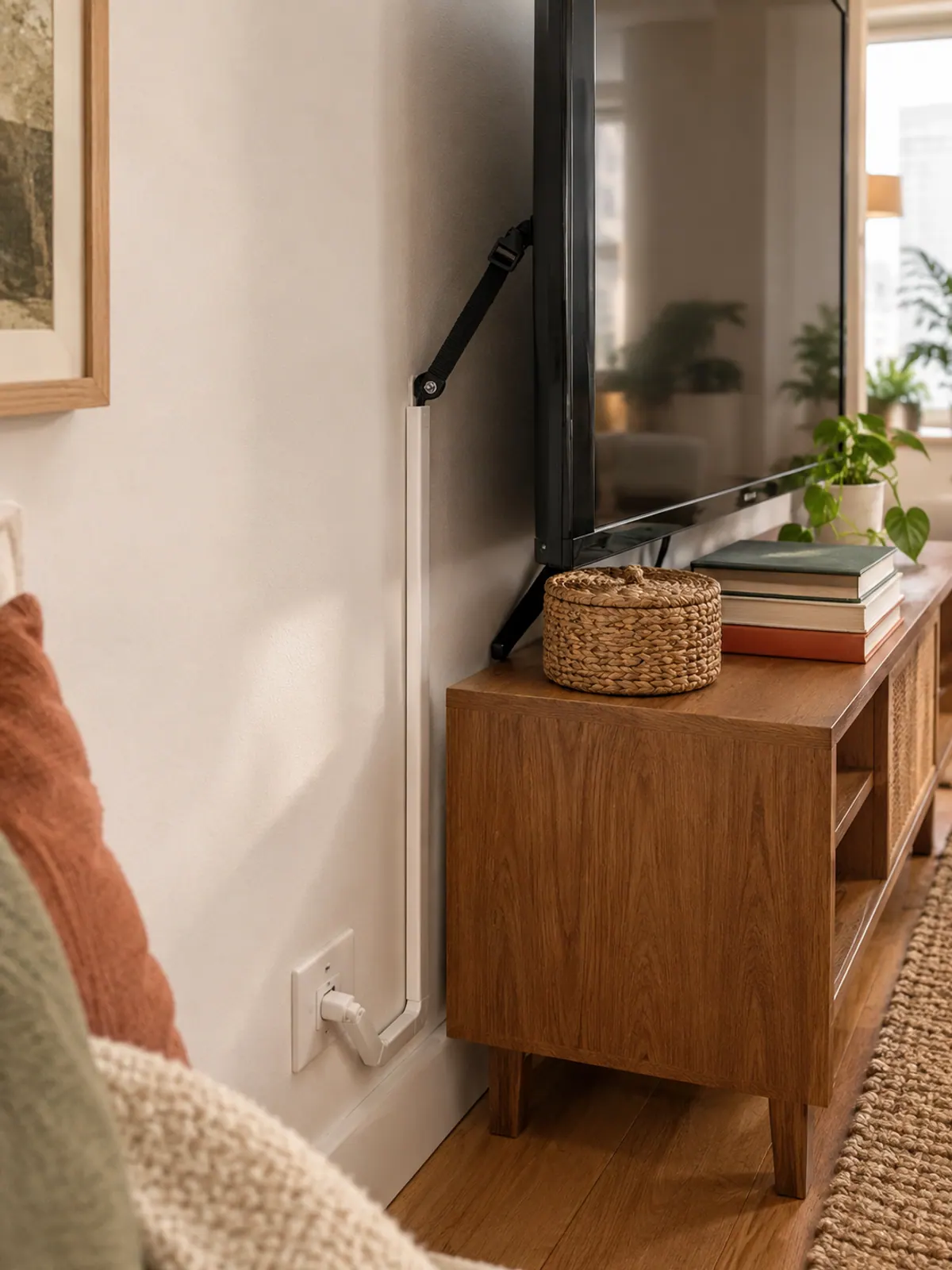
TV anti-tip strap kit
Typically $10 to $20
Connects the TV to its stand or wall to keep it from tipping over.
Check price on Amazon for TV anti-tip strap kit -
Paintable cord cover raceway
Typically $12 to $30
Hides the cable run down the wall so the TV wall looks finished.
Check price on Amazon for Paintable cord cover raceway -
Small swivel accent chair
Typically $150 to $400
Turns toward the TV for a movie and back toward the sofa for conversation.
Check price on Amazon for Small swivel accent chair
Plan it on paper before you move a thing
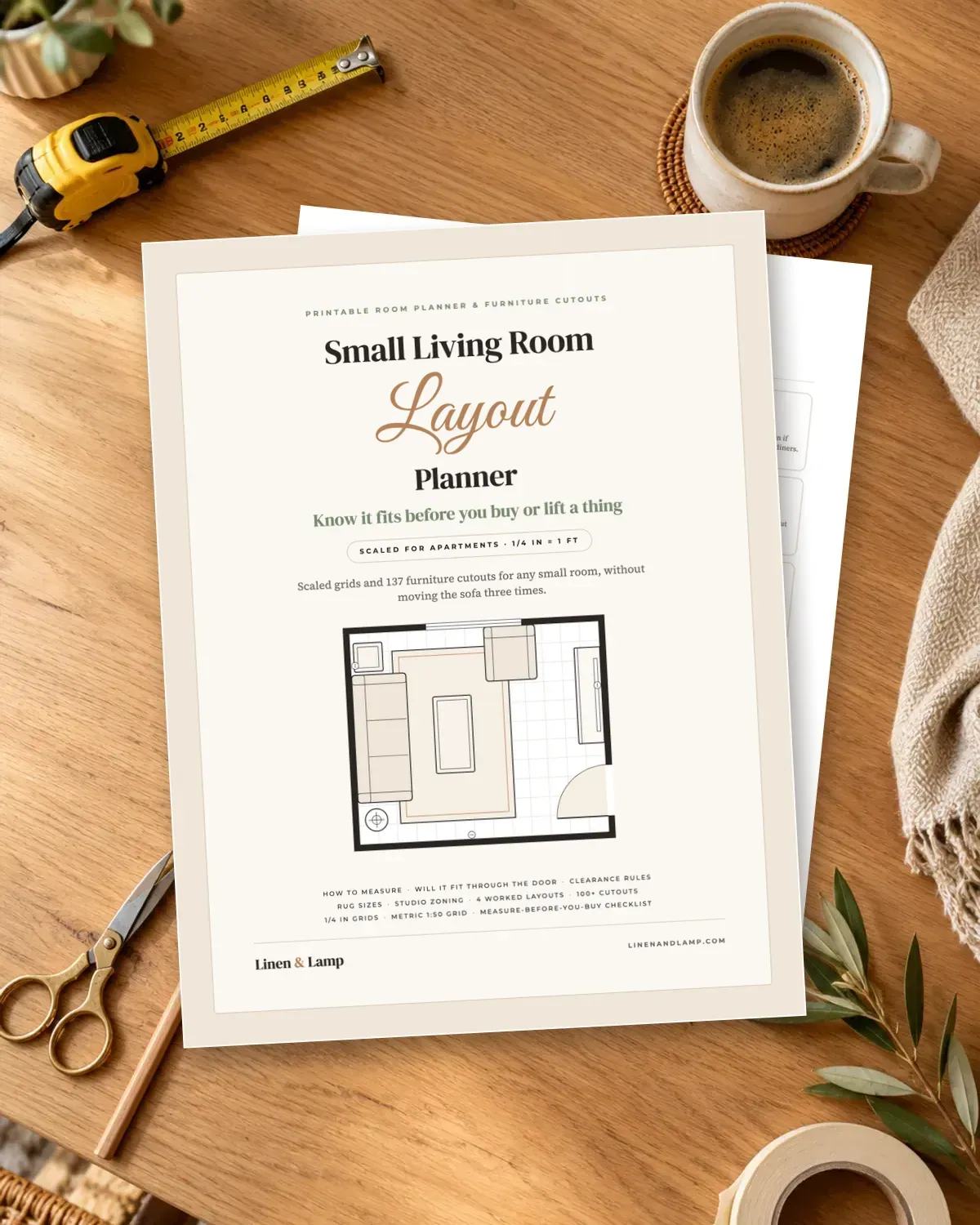
Moving a sofa three times is how a weekend disappears. Draw the room to scale, cut paper shapes for each piece, and try every layout above in ten minutes before you lift anything.
Frequently asked questions
Where should a TV go in a small living room?
Put it on a wall that is not opposite or in front of a window, ideally at a right angle to the main window. Then set the sofa across from it at about 1 to 1.5 times the screen size away.
How far should the sofa be from the TV in a small living room?
For a 4K TV, about 1 to 1.5 times the screen size. That is roughly 4.6 to 6.9 feet for a 55 inch TV and 3.6 to 5.4 feet for a 43 inch TV.
How high should a TV be in a small living room?
Aim for the middle of the screen near seated eye level, about 40 to 42 inches from the floor for most sofas. A low console usually gets you there without mounting.
Can I put a TV in a corner?
Yes. A corner TV stand angles the screen toward the room and frees up the long walls. Avoid corners right next to a bright window.
How do I arrange a small living room with a TV and no wall mount?
Use a low console, a floor stand with a built-in mount, or a rolling stand. All three hold the TV at a good height with no holes, and you can secure the TV with an anti-tip strap.
Save it for later
Pin this to your Living Room board so it's there when you need it.
Save to Pinterest